
Autism Spectrum Disorder (ASD) — An Elaborated Overview
What is Autism?
Mainly there are three ‘3’ types ..
1. Autism by Birth (Congenital Autism)
2. Genetic Autism
3. Virtual Autism Caused by Smartphone Addiction.
Autism Spectrum Disorder (ASD) is a complex neurodevelopmental condition that affects how a person perceives, processes, and interacts with the world around them. It is called a "spectrum" because it encompasses a wide range of symptoms, abilities, and levels of severity no two autistic individuals are exactly alike.
It primarily impacts:
Social communication and interaction
Behavioral patterns (often repetitive or restricted)
Sensory processing
Cognitive and emotional regulation
Core Diagnostic Features
Social Communication Deficits
Difficulty understanding social cues, facial expressions, or body
language.
Trouble maintaining conversations or forming relationships
Limited use of gestures or eye contact
May not respond to their name being called
Restricted & Repetitive Behaviors (RRBs)
·
Repetitive movements (rocking, hand-flapping, spinning)
Rigid routines — extreme distress when routines change
Intense, narrow interests
Hyper- or hypo-sensitivity to sensory input (sound, light, texture, pain)
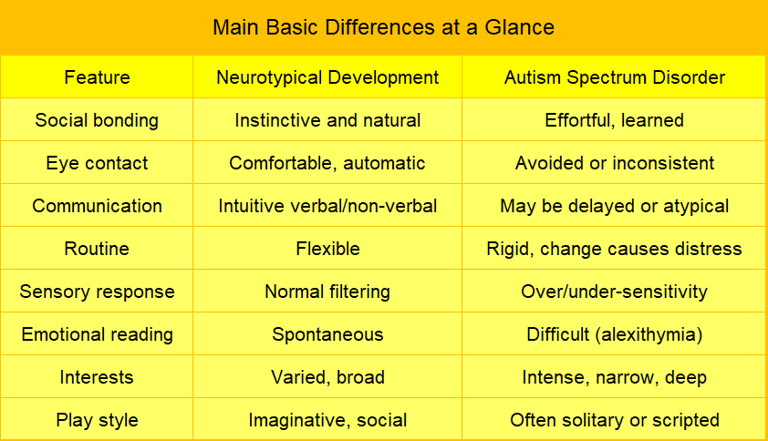
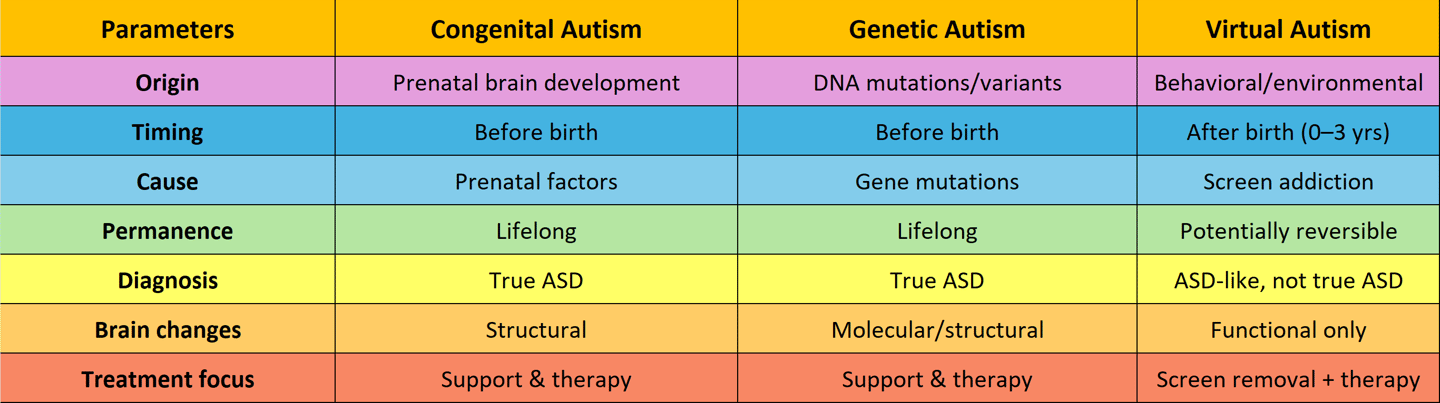
Autism by Birth (Congenital Autism)This refers to autism that is present from birth, arising during prenatal brain development. It is the most classical and well-recognized form.
How it happens:
During fetal development (In 6–24 weeks of pregnancy) atypical neural migration, synapse formation, and brain connectivity patterns occur. These lead to structural and functional differences in:
The amygdala (emotion processing)
The prefrontal cortex (social behavior, decision-making)
Mirror neuron systems (empathy and imitation)
Prenatal risk factors:
Advanced parental age at conception
Maternal infections during pregnancy (rubella, CMV)
Exposure to certain medications (e.g., valproic acid, thalidomide)
Maternal immune system irregularities
Extreme prematurity or birth complications (oxygen deprivation)
Nutritional deficiencies (folic acid, Vitamin D)
Key signs (detectable early):
Lack of social smile by 6 weeks
No babbling by 12 months
No pointing or waving by 12 months
Loss of previously acquired language skills
Genetic Autism
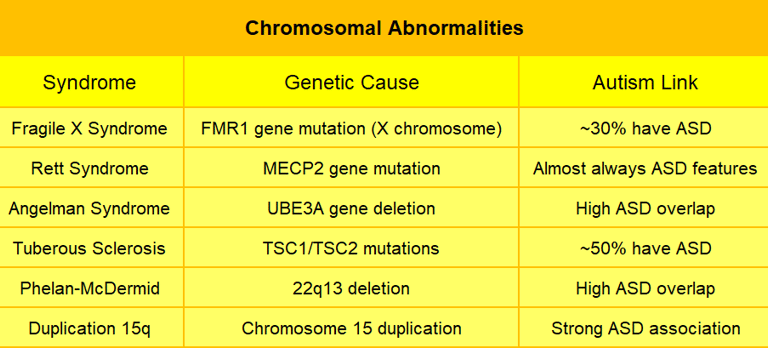
Genetics play the most significant role in autism causation. Research shows ~80% heritability in autism.
Types of Genetic Causes:
Inherited Gene Variants - Passed from parent to child through common genetic variations (polygenic). Parents may carry subclinical traits (the "broader autism phenotype") without a full diagnosis.
De Novo Mutations 'Spontaneous mutations' - Not inherited from either parent, but arise fresh in the egg, sperm, or early embryo. These are often associated with more severe presentations.
Key Genes Implicated in Autism:
SHANK3 — synapse scaffolding
NRXN1/CNTN — neuronal connection
CHD8 — chromatin regulation
SYNGAP1 — synaptic signaling
DYRK1A — brain growth
Important note:
No single "autism gene" exists. It is a polygenic condition — hundreds of genes interact, and environment can switch them on or off (epigenetics).
Virtual Autism — Caused by Smartphone & Screen Addiction
This is the newest and most debated category, particularly relevant in the modern digital age.
Definition:
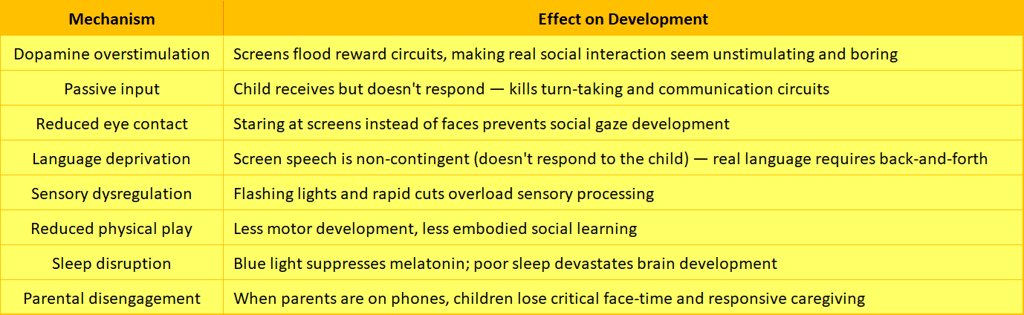
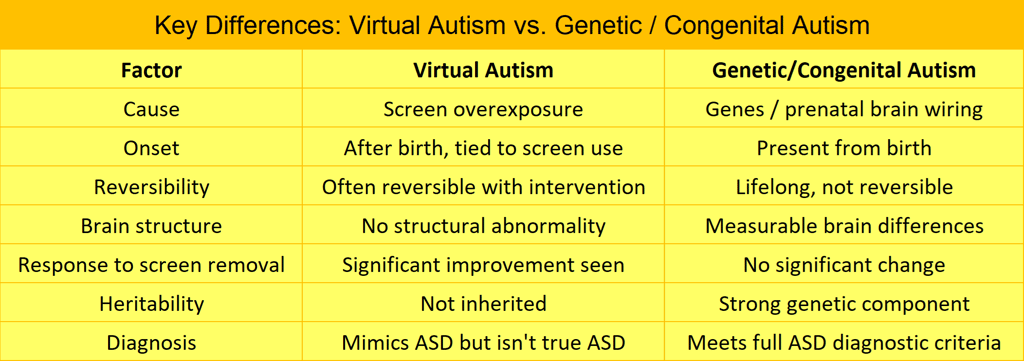
Virtual Autism, Coined by Romanian psychologist Marius Zamfir, ~2018) describes a set of autism-like symptoms that develop in neurotypical children (children born without autism) due to excessive, early screen exposure particularly before age of 3, when the brain is in its most critical developmental window. Important distinction: Virtual autism is not true ASD — it is a functional, behavioral syndrome that mimics autism. With intervention, it can be partially or fully reversed, unlike genetic/congenital autism.
Why Age 0–3 Matters So Much:
The infant and toddler brain is in its peak neuroplasticity phase. During this time:
Language circuits are being wired
Social bonding patterns are established
Emotional regulation systems form
Sensory integration develops
Screen time during this window replaces the real-world human interactions the brain needs to wire these systems correctly.
Symptoms of Virtual Autism (mirror real ASD):
Speech delay or regression
Poor eye contact
Social withdrawal
Repetitive behaviors or tantrums
Hypersensitivity to sound/touch
Short attention span
Emotional dysregulation
Preferring screen to human interaction
Prevention & Reversal of Virtual Autism:
Prevention:
Zero screen time for children under 18–24 months (WHO & AAP guidelines)
Max 1 hour/day of high-quality content for ages 2–5, with a parent present
Prioritize face-to-face interaction, outdoor play, and reading aloud
Intervention (if symptoms appear):
Immediate and total screen detox
Intensive parent-child interaction therapy
Speech and language therapy
Play therapy and sensory integration
Structured social play groups
Results can be dramatic — many children recover significant language and social skills within months.
N.B: Autism in all its forms deserves understanding, not stigma. Whether congenital, genetic, or virtual, early identification and appropriate support make an enormous difference in quality of life and developmental outcomes.
Get in touch with Us...with Just a Click
Head Office - 8/1A HATI BAGAN CIT Road 'ENTALLY' Park Circus, Kolkata - 700 014.
Get in touch with Us...with Just a Click






Website Powered & Designed by Arshad Sattar